The Engineering Behind an Office Chair for Neck Pain

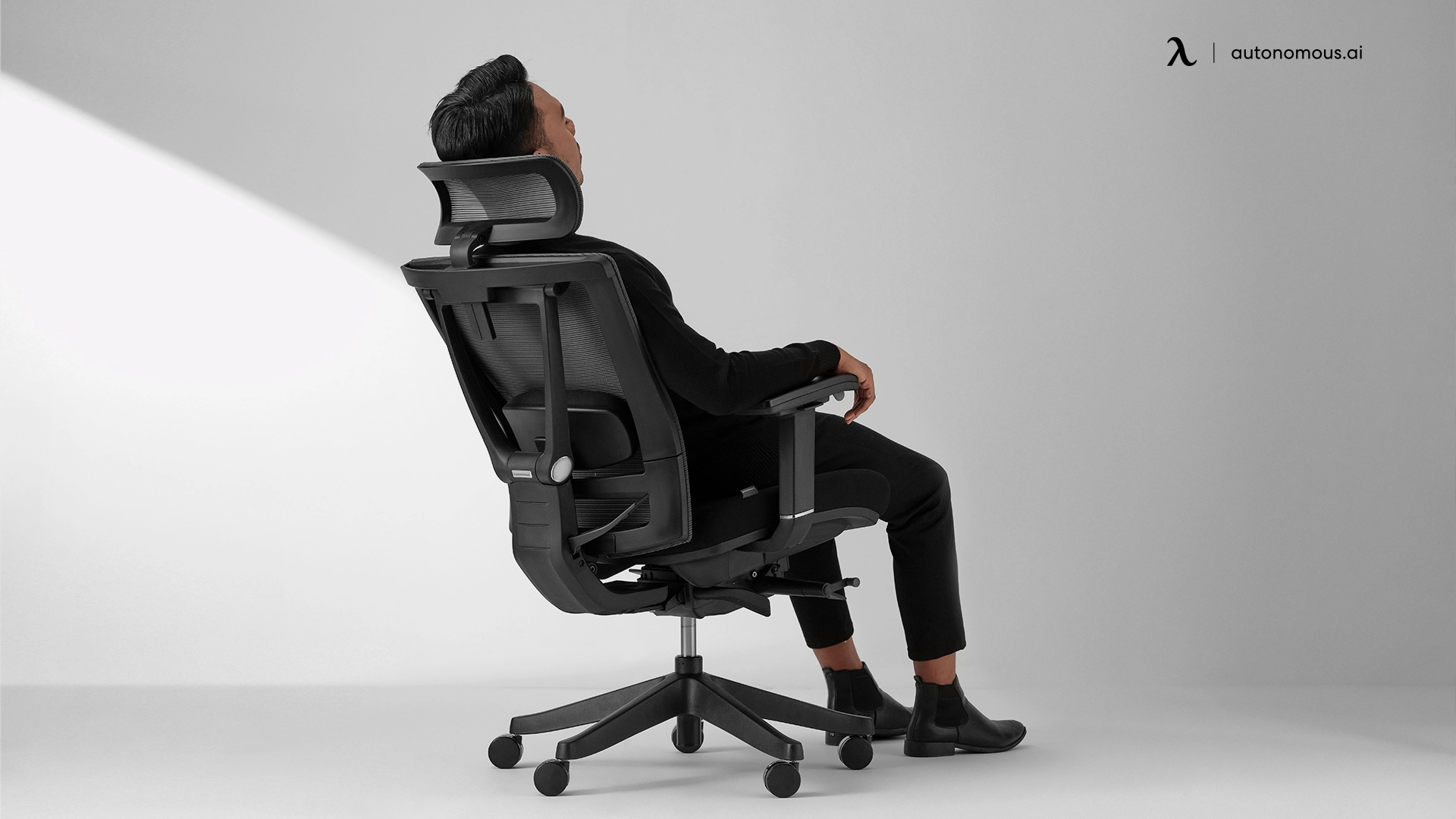
If you have neck pain at a desk, your chair is doing one of four things wrong. The headrest isn't there, or it pushes your head forward. The lumbar doesn't reach your lower back, so your thoracic spine collapses and pulls the neck with it. The armrests sit too low, so your shoulders carry the weight of your forearms. Or the recline doesn't lock, so your neck stabilizes your head against gravity for eight hours.
I work on the team that designed the ErgoChair Pro. This article walks through each of those four mechanisms, what the research says about how they produce cervical pain, and how the Pro's geometry was engineered against each. Where the chair has limitations, I'll name them.
How desk work causes neck pain
Neck pain is one of the most common musculoskeletal complaints among computer workers. Multiple studies have found that workers in sedentary, computer-intensive jobs have a higher incidence of neck pain compared with many other jobs. The root cause is mechanical: forward head posture.
The math is unforgiving. A neutral human head weighs 10–12 lb. A study published in Surgical Technology International found that while the head weighs 10-12 pounds in a neutral position, tilting it forward by just 15 degrees increases the effective load on the cervical spine to 27 pounds. At 30 degrees forward, that load roughly doubles again. Multiply by eight hours, five days a week, and the chronic strain pattern most desk workers describe - the band of tension across the trapezius, the deep ache at the base of the skull, the stiffness that takes ten minutes to walk off - is the predictable end state.
The research is direct about the cause. Office employees had a defective posture while working and the improper posture was more severe in the office employees who suffered from neck pain. Posture is the variable. Posture is what a chair can change.
A chair designed against neck pain has to do four things, each tied to a specific mechanism:
- Hold the head at the cervical spine's neutral angle - through a properly positioned headrest.
- Support the lumbar curve - so the upper back doesn't collapse forward and pull the neck with it.
- Carry the weight of the arms - so the shoulders don't compensate by tightening the upper trapezius.
- Allow controlled recline - so the neck periodically offloads the head's weight onto the backrest.
Here is how the ErgoChair Pro was engineered against each.
1. The headrest - angle and contact point
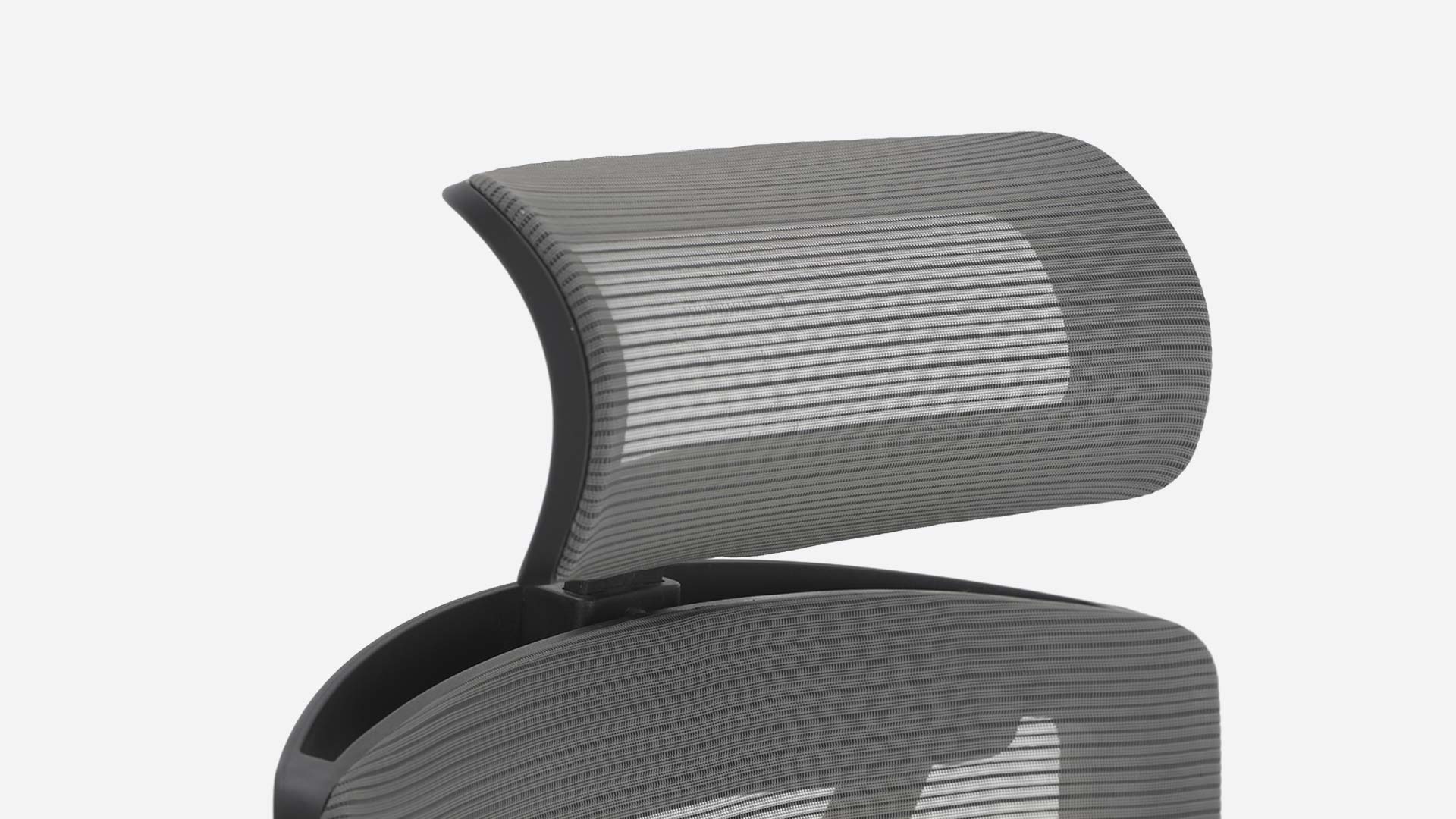
A headrest only works if it contacts the right part of the skull. The firmest point of the headrest should make contact with the back of the skull, not the soft tissue of the neck. When the skull is supported at this pivot point, the cervical spine can maintain its natural lordotic curve without external pressure forcing it forward.
A headrest set too low pushes against the neck and forces the head forward - the opposite of what it's meant to do. A headrest set too high gives no contact at all. The ErgoChair Pro's headrest adjusts in both height and tilt angle, so the contact point can be set to the external occipital protuberance - the bony ridge at the base of the skull - for any user between roughly 5'0" and 6'4".
Critically, the headrest is included at the $499 base price. This matters because the most common compromise chair shoppers make for neck pain is buying a chair without a headrest to save money, or adding the headrest as a $70–$100 upsell that gets skipped. A chair without a headrest cannot support cervical alignment during recline. There is no software fix for missing hardware.
2. The lumbar - sliding support that meets the lower back
Neck pain is rarely a neck problem. It is usually a lumbar problem that traveled north. When the lower back loses its curve, the thoracic spine collapses forward to compensate. The shoulders roll inward. The head drifts forward to maintain eye line. The neck stabilizes the head against gravity, hour after hour, until the trapezius and the suboccipital muscles fail.
The fix has to start at the lumbar. When neck pain is related to long-term poor posture, switching to good ergonomics alone may not be enough to relieve the pain. Most recommendations include performing stretches and exercises to reduce forward head posture in addition to using better ergonomics as part of the overall treatment plan. The chair is the foundation; everything else is downstream.
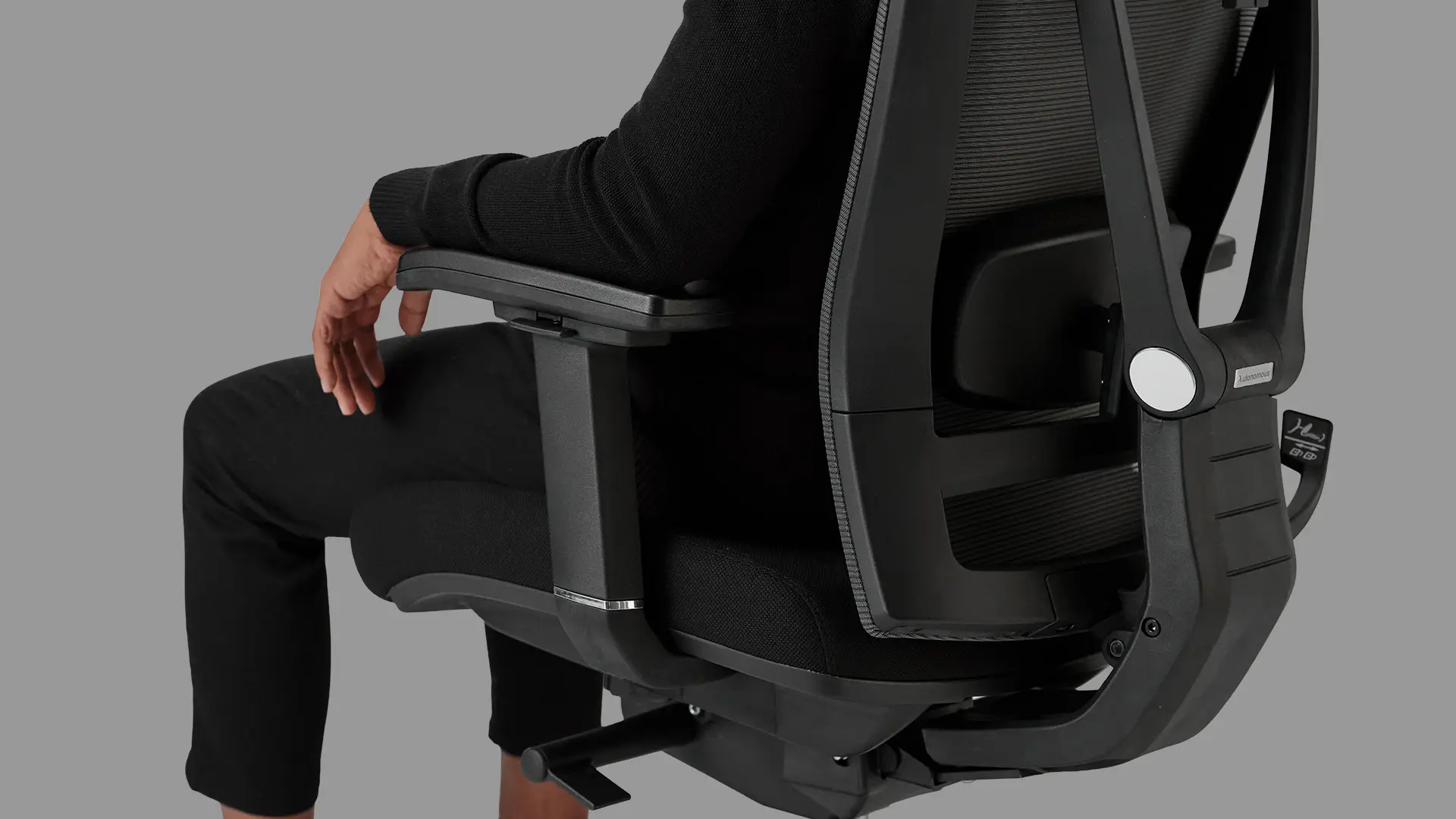
The Pro's lumbar slides 6" along the backrest and flexes forward as you shift. The slide range covers the L3–L5 region for users between 5'2" and 6'4". The flex allows the support to follow you when you lean - most fixed lumbar pads disengage the moment you change posture, which is when cervical strain accumulates most.
The engineering rationale is documented on the chair ergonomics breakdown: nine adjustment points across eleven axes, designed so the chair fits each segment of the spine independently rather than as a single shape.
3. The armrests - carrying the weight of the arms
Each arm weighs about 5–6% of body weight. For a 170 lb person, that's roughly 9–10 lb per arm, or 18–20 lb total hanging from the shoulder girdle. When armrests don't support the arms at the right height, the upper trapezius takes the load. The trapezius runs from the base of the skull down to the mid-back. Loading it for eight hours produces the exact band of tension most desk workers describe as "neck pain."
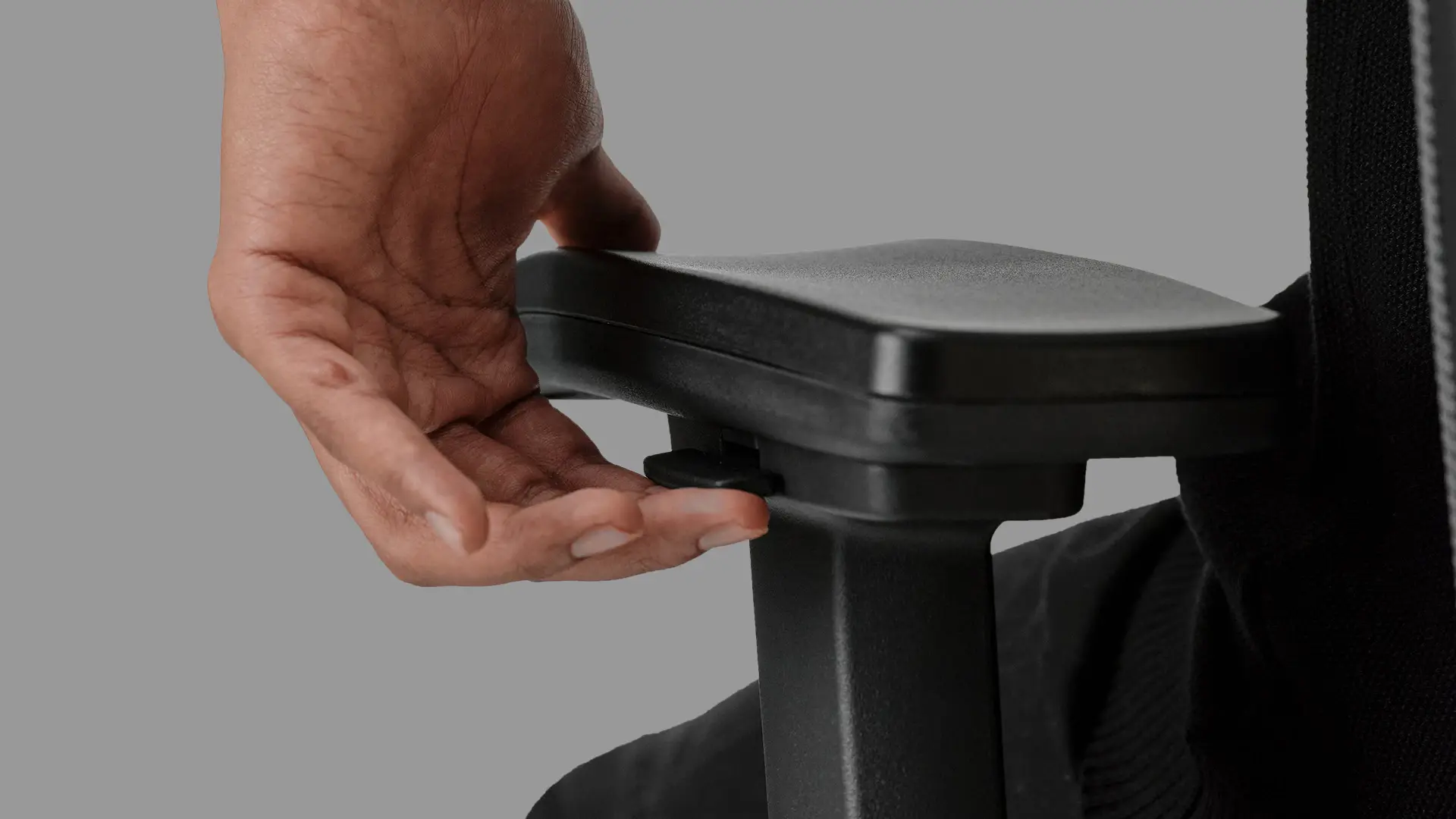
The Pro uses 3D armrests adjustable in height (11" to 14" above the seat), width, and forward/back position. The 11" minimum height is critical for shorter users - most chairs bottom out at 9–10" above the seat, which is too high for a 5'2" user at a standard 29" desk. The arms have to drop below the desk underside or they push the shoulders up.
The setup target: forearms parallel to the floor, elbows at roughly 90 degrees, shoulders relaxed. If you can drop your shoulders an inch when the arms are at their current position, the arms are too high. If your shoulders shrug to reach the pad, they're too low or too wide.
4. Synchro-tilt - offloading the head's weight
The fourth mechanism is the one most chair guides miss: the head is heavy even in neutral posture, and the neck cannot hold it for eight straight hours without breaks. The cure isn't standing up every 30 minutes - it's a chair that lets you recline at controlled intervals so the headrest carries the load while you stay productive.
The Pro's synchro-tilt mechanism reclines 22° across five lockable positions. The seat and backrest move at a 2:1 ratio - for every 2° the back tilts, the seat tilts 1°. This keeps the thighs supported through the recline rather than sliding forward, which is what produces the slumped-down posture that defeats most reclining chairs. The Donati mechanism (Italian-built, 100,000-cycle tested) provides the smoothness that makes the recline usable as a working position, not just a break.
Lock the recline at position three or four during reading and calls. The headrest carries the head, the lumbar supports the lower back, and the upper trapezius gets twenty minutes off. Cornell ergonomics research recommends regular postural change during the workday for exactly this reason - alternating between upright work and supported recline reduces the cumulative load that drives chronic neck pain.
What the chair cannot fix
Three things are worth naming.
Screen height. If your monitor sits below eye level, the chair cannot prevent forward head posture - your eyes will pull your head down regardless of the lumbar setting. The monitor's top edge should be at or just below seated eye level. A laptop on a desk fails this test universally; a stand or external monitor is the fix.
Sitting time. Even a well-engineered chair cannot eliminate the static load of eight hours of sitting. The Cornell rhythm - roughly 20 minutes sitting, 8 minutes standing, 2 minutes moving - is the consensus recommendation. A standing desk paired with a chair does more than either alone.
Pre-existing structural conditions. Disc herniation, cervical radiculopathy, and other diagnosed conditions need clinical care. A chair is preventive infrastructure; it is not a treatment.
Bottom line
Neck pain at a desk is a load problem. The head is heavy, the cervical spine is small, and eight hours of static load with bad geometry breaks down the trapezius and the suboccipitals. The ErgoChair Pro was engineered against the four mechanisms that produce that load: a headrest that holds the skull neutral, a lumbar that supports the lower back through posture changes, armrests that carry the arms at the right height, and a synchro-tilt recline that offloads the head's weight periodically. At $499 with the headrest included and a lifetime warranty, it covers the mechanical foundation. The rest - screen height, breaks, movement - is your part.
References
- Green, B. N. (2008). A literature review of neck pain associated with computer use: public health implications. Journal of the Canadian Chiropractic Association, 52(3), 161–167.
- Nejati, P., Lotfian, S., Moezy, A., & Nejati, M. (2015). The study of correlation between forward head posture and neck pain in Iranian office workers. International Journal of Occupational Medicine and Environmental Health, 28(2), 295–303.
- Lee, H., & Lee, Y. (2024). Effects of postural changes using a standing desk on the craniovertebral angle, muscle fatigue, work performance, and discomfort in individuals with a forward head posture. Healthcare, 12(23), 2436.
- Hansraj, K. K. (2014). Assessment of stresses in the cervical spine caused by posture and position of the head. Surgical Technology International, 25, 277–279.
- Hedge, A. (2015). Cornell University Human Factors and Ergonomics Research Group. Active sitting and the 20-8-2 rule.
- Cagnie, B., Danneels, L., Van Tiggelen, D., De Loose, V., & Cambier, D. (2007). Individual and work related risk factors for neck pain among office workers: a cross sectional study. European Spine Journal, 16(5), 679–686.
- BIFMA G1-2013. Ergonomics Guideline for Furniture Used in Office Work Spaces Designed for Computer Use.
- OSHA. Computer Workstations eTool - Good Working Positions. U.S. Occupational Safety and Health Administration.